

The First Pancake
I knew from my prompt engineering course that I couldn’t just ask ChatGPT to make me a superhero. But I thought I would try anyway. When I asked for a single panel introducing a new superhero named Captain Democracy, what I got was Captain America with a “D” on his forehead. I knew AI bots tended to be derivative without clear, unambiguous prompts. But I was hoping to avoid a major lawsuit right out of the gate. Also, note that the speech bubble seems to be pointing to both potential speakers.
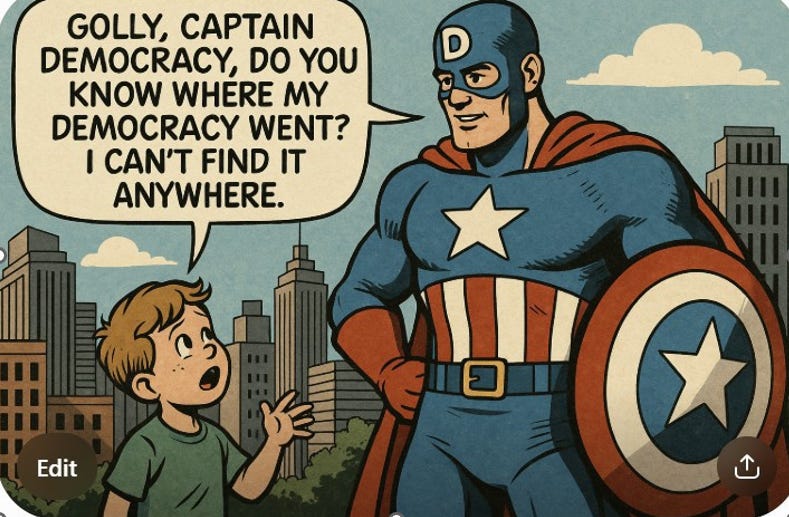
The next iteration gave me this guy. An improvement? Not so sure. But at least less likely to be met with a cease-and-desist order from a mouse.
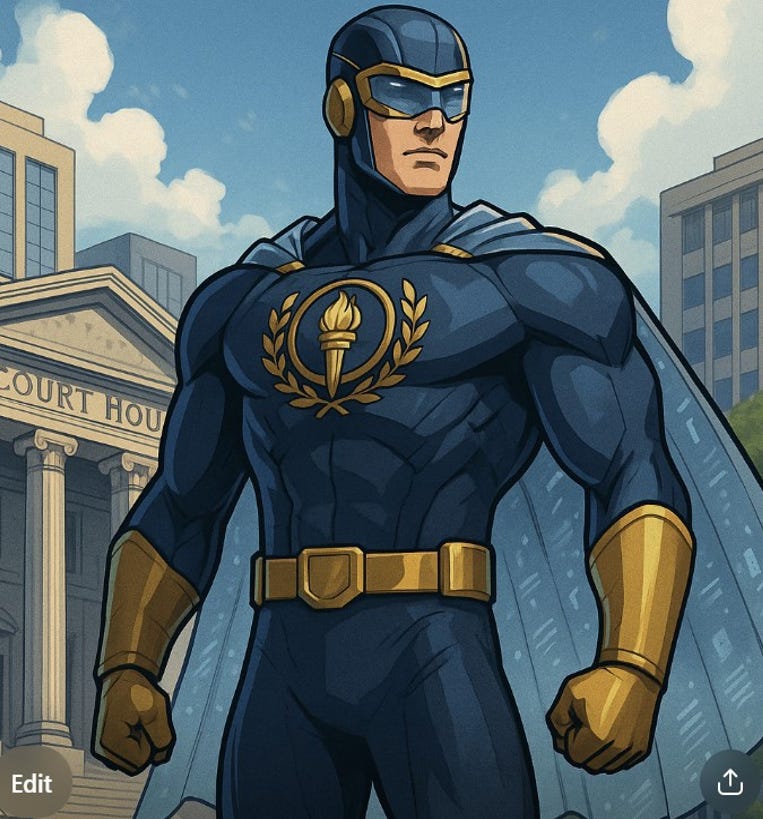
Though this is not the prototype I ended up using, it was a vital part of my thought process. I didn’t like it at all, but by articulating why, I discovered what I really wanted. The guy above is a perfectly serviceable hero. Strong, mysterious, color-coordinated. But Captain Democracy isn't supposed to be a heroic hero; he's a satirical one. This guy looks like he has never cracked a joke in his life.
Even more importantly, Captain Democracy is the personification of democracy itself, and I don’t see democracy—especially American democracy in the Trump era—as noble or heroic. I wanted my hero to be hapless, bumbling, and out of shape, but also plagued with good intentions that perpetually exceeded his ability to put them into effect. This is the democracy that Winston Churchill described as the worst form of government on earth, except for all the others.
My Captain Democracy has amazing powers, like flight and super strength, but they never seem to help him much. He ends up bumbling his way to victory most of the time because his intentions are so noble, and yet so impractical, that the world can’t help but conform to his expectations from time to time—usually out of pity, but also because we all harbor the secret hope that the world will live up to the expectations of its inveterate optimists. This is Mr. Smith Goes to Washington, with Mr. Smith played by someone who looks more like a middle-aged Danny DeVito than a young Jimmy Stewart.
So, I wrote my final prompt in the design iteration process.
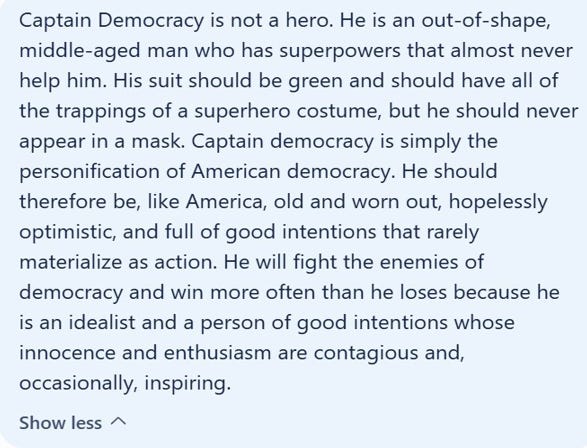
The first Captain Democracy strip appeared on my Facebook page on my 59th birthday, June 29, 2025.
Now that I had a hero and a proof of concept, it was time to create a strip. But I had a problem: a hero and some villains were the extent of my planning. Actually, having them do things—things that conveyed sharp social satire while providing a reliably hilarious punch line in every fourth panel—turns out to be harder than I thought. So I turned my first strip over to ChatGPT and just said, “Create a funny strip about the dysfunctions of democracy using Captain Democracy as the hero.” This is what it came up with. It was not very good.
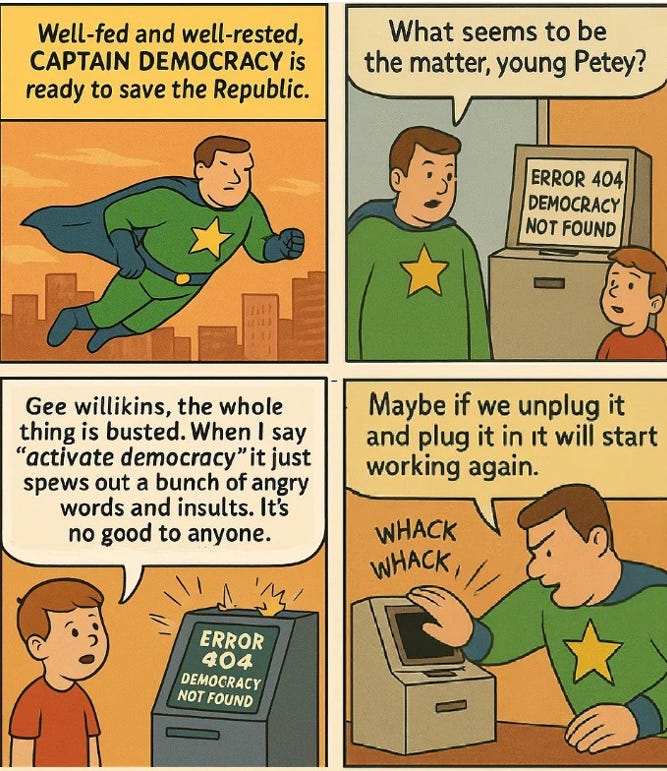
This was not a good strip. It conveyed the entire argument in four panels. There was no way to draw it into four or five installments, as Garry Trudeau and Berkeley Breathed always managed to do with Doonesbury and Bloom County. In desperation to get more than one strip out of an idea—albeit not a very good idea—I asked ChatGPT to write a prequel strip in which Captain Democracy gets an emergency phone call and can’t wake up. So it became a two-strip sequence (and one I didn't load onto the Captain Democracy Substack page when I took the strip public).
And thus was born, only to die immediately thereafter, the first iteration of the Captain Democracy comic strip.
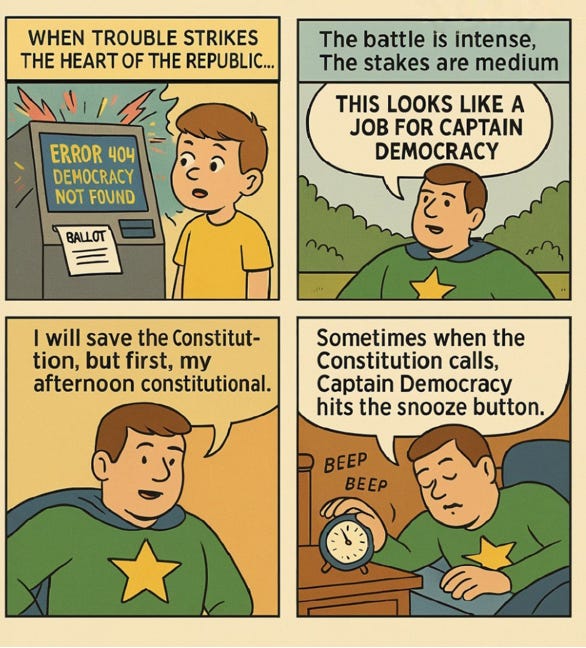
These early strips never made it to the Substack page. They appear here in public for the first time in their proper role as cautionary tales. They show problems that arose when I tried to have ChatGPT do everything, both draw the pictures and write the script. Make no mistake, the chatbot was eager to do it all. It assured me that it could think of the scenario, write the dialogue, and produce the entire strip.
When I did this, I ended up with something more like Nancy than Doonesbury: self-contained sight gags, rather than extended satirical narratives. The strips were one-off sight gags conveying neither nuance nor complexity. Fine for filling empty column inches, but not what I wanted to do with my first shot at a lifelong dream. I never handed the reins back to ChatGPT.
But doing it myself meant that I needed to learn a lot more about non-AI graphic design. Ironically, the more I used AI, the more non-AI skills I had to acquire. When I created the first strip, I had to prompt ChatGPT for each panel, and without a tool to put four panels together into a coherent comic strip, I laid everything out in Microsoft Paint. Over the next six months, while I was teaching myself how to prompt a Large Language Model effectively, I also had to teach myself how to use the following programs or websites:
GIMP (GNU Image Manipulation Program), an open-source alternative to Photoshop, became the first photo-manipulation program I could use successfully.
Krita, an open-source drawing program, has a special plug-in for comic artists. This let me insert speech bubbles and tails, freeing me from needing ChatGPT to render the text perfectly the first time, which it was never quite able to do.
Canva, an online, subscription-based graphic-design suite, allowed me to create templates that quickly turned four different images into a coherent comic strip with a consistent top panel.
Artistly, an AI image generator with a one-time purchase price, never generated Captain Democracy panels from scratch, but it proved remarkably effective at removing stray arms, legs, and other stray objects from panels where they clearly did not belong.
Substack, which I had never used before, is an excellent platform for disseminating articles (and more importantly, comic strips) through both its web page and through subscription-based emails.
From the educational perspective, even if I had never produced a single panel, learning how to use these tools was worth the time I invested in the comic strip enterprise. I have used all these programs and websites for other projects, and they are now part of my professional toolkit. And when I decided to collect all the Captain Democracy strips into a book (which, dear reader, you now hold in your hand), I added professional layout software, Adobe’s InDesign, to that toolkit. Producing Captain Democracy did not exactly take a village, but it did take a hard drive.
Herein, I believe, lies the greatest educational promise of artificial intelligence. When AI extends our ability to do things that were previously beyond our reach, it also requires us to acquire new competencies to turn those possibilities into finished work. When teachers understand this, and when students grasp what they can actually accomplish with the help of AI models, classroom assignments can become a gateway to releasing human potential, unlocking knowledge locked away by limitations AI can help us overcome.
As a longtime writing teacher, I am quite sure that AI will be the end of the thesis-driven five-paragraph essay assignment. I do not mourn its loss. Five-paragraph essays do not occur in the wild, and thesis statements were never anything more than rhetorical training wheels. Teachers who still give such assignments deserve the AI-generated drivel they will almost certainly receive.
But look what we can now put in its place. How about a final assignment to write a full-length opera or a symphony, or a history of a nearby town? With AI, freshman English students might create a graphic-novel version of Moby-Dick or Great Expectations. Or how about a full video version of The Iliad or Dante’s Inferno?
AI can help students do things like this. But it can’t do them on its own. Or, at least, it can’t do them well. To accomplish a major project using AI, students will have to learn how to prompt a chatbot multiple times over weeks or months. They will have to learn how to put different pieces of a project together. They will also have to master production and organization technologies capable of creating the final project that AI will help them create.
Ultimately, this is what Captain Democracy taught me: artificial intelligence can remove the barriers that make certain things impossible, but making something possible does not make it inevitable. AI has opened up a world of opportunities, but most of them are wearing overalls and looking a lot like work.
Quite quotable, I love it, thanks: "AI has opened up a world of opportunities, but most of them are wearing overalls and looking a lot like work."
Thanks for sharing these details, Michael. As is the case with most superheroes, Captain Democracy's origin story is the most compelling part of the narrative.